
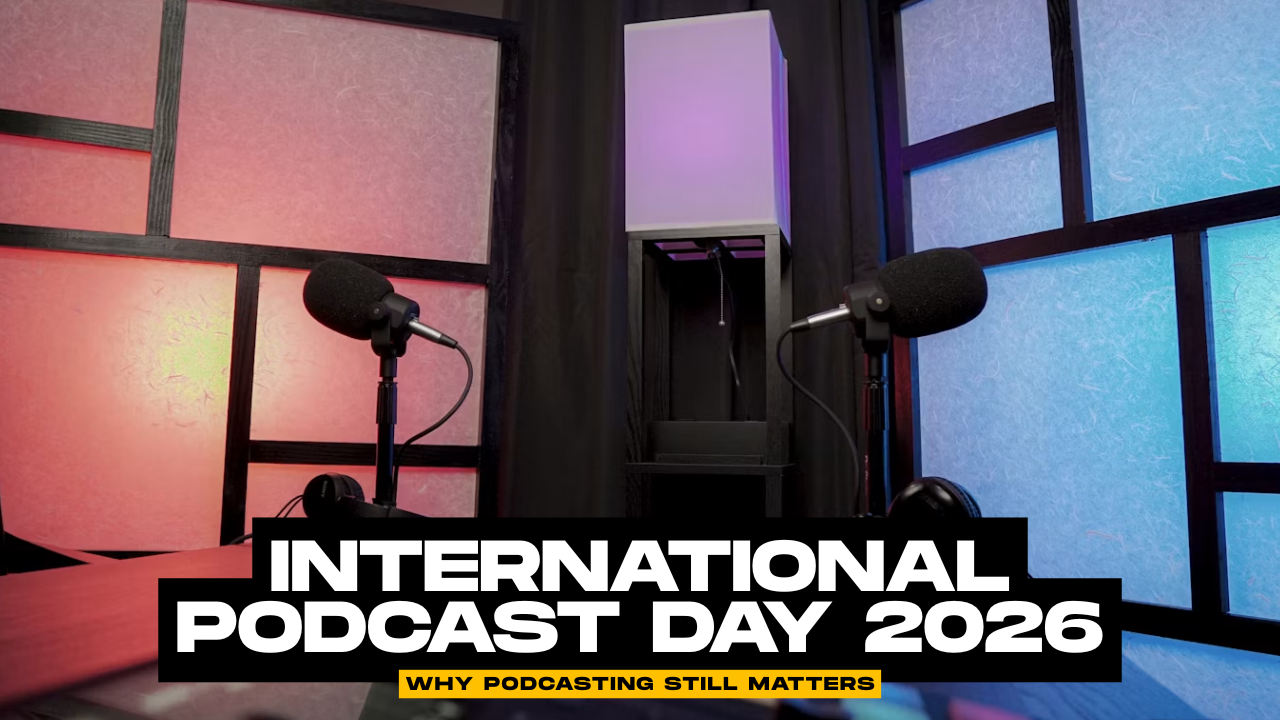
International Podcast Day 2026: Why Podcasting Still Matters
Hey Podcast Fam,
Today is International Podcast Day, a global celebration of the conversations, stories and voices that make this medium what it is. And what a medium it's become.
Podcasting started as something you mostly heard through a pair of headphones. Today, shows live on Spotify, Apple Podcasts, YouTube and beyond. They show up as social clips, newsletters, live events, communities and entire brands.
The audience has grown right alongside it. Edison Research's Infinite Dial 2026 found that 58% of Americans age 12 and older, roughly 167 million people, consumed a podcast in the past month. That's a record.
So on a day built to celebrate podcasting, we want to talk about what's changed, what hasn't, and what it means for your show.
1. Podcasting Is No Longer Just Audio
A podcast still starts with a conversation. But that one conversation can now power an entire content ecosystem.
A single recording session can become:
- A full-length video episode on YouTube
- Short-form c...
Trust Is the New Reach — What The Podcast Study 2026 Means for Your Show
Hey Podcast Fam,
There’s plenty of conversation in podcasting about reach — bigger platforms, stronger algorithms, more clips, more impressions.
But some of the newest research is pointing to something even more valuable:
The relationship between a host and their audience.
The Podcast Study 2026 recently shared its first findings at the Sounds Profitable Business Summit, and several other research groups have released similar findings around the same time.
The common thread?
Listeners aren’t just choosing shows.
They’re choosing voices they trust.
The Headline: Hosts Are the Product
The Podcast Study 2026 surveyed more than 1,200 podcast consumers nationally, with Crooked Media, NPR, and PRX signed on as co-sponsors.
The framing of the presentation says a lot on its own:
“Buying Trust, Not Just Reach.”
A few numbers worth sitting with:
- 82% of listeners said the host is a major reason — or the only reason — they listen to their favorite podcast
- 88% said they spend at le...
Spotify Is Testing an Ad-Skip Button — Here's What It Means for Your Show
Hey Podcast Fam,
Spotify is quietly testing a new feature called "Skip Ahead," and if you run an ad-supported show, it's worth twenty minutes of your attention.
The short version: it's a one-tap button that lets Premium listeners jump straight past ad breaks, sponsor reads, and subscription promos. It hasn't been officially announced yet, but it's already showing up for some Premium users in the US and UK.
Here's what's actually happening, what it means for creators, and — more usefully — what to do about it regardless of how it plays out.
What Skip Ahead Actually Does
When an ad break, intro, or promo starts playing, a button appears on screen. One tap sends the listener straight to the beginning of the next segment.
It's a small interaction, but it removes a real amount of friction. Manually skipping the same length of ad content can take close to ten taps on the standard "skip 15 seconds" control. Skip Ahead gets it down to one.
It's currently been spotted across shows carryi...
How AI Search Engines Are Changing Podcast Discovery
Hey Podcast Fam,
The way people find your show is changing faster than most creators realize. It's not just about ranking in Apple Podcasts search or hoping Spotify's algorithm picks you up anymore.
A growing share of your future audience isn't searching at all — they're asking. ChatGPT, Perplexity, Claude, and Google's AI Overviews are becoming a real discovery layer, and most podcasts aren't set up to be found through it.
Here's what's actually changing, why it matters more for audio than almost any other content format, and what to do about it.
What "AI Search" Actually Means for Podcasters
Traditional search sends someone a list of links and lets them decide. AI search skips that step — it reads across the web, synthesizes an answer, and hands the listener a direct response, often with just a handful of cited sources. Daily use of AI search tools in the US has grown sharply over the past year, based on research from HigherVisibility, and that shift shows no signs of slowing d...
Why 2026 Is the Year of the Micro-Podcast
Hey Podcast Fam,
Long-form episodes still have their place, but more listeners are gravitating toward something they can actually finish in one sitting.
As the industry keeps pivoting away from content bloat, more shows are moving toward micro-podcasting: short, high-impact episodes built for the "in-between" moments of the day — the commute, the coffee, the walk to the mailbox.
What This Means for Creators
In 2026, the most valuable thing you can give an audience isn't more information — it's more of their time back. The data backs this up. Podcasting already has one of the best completion rates in media — around 70–72% of listeners finish most or all of an episode, industry-wide.
Shorter episodes push that even further: shows under 30 minutes see completion rates run 5 to 20 percentage points higher, since they fit neatly into a single sitting instead of competing with the day's interruptions. In other words, runtime is one of the most reliable levers creators have for getting...
Clips Aren’t Enough Anymore: Why Vertical Video Is Podcasting’s Next Shift
Hey Podcast Fam,
For the last few years, “video podcast” has largely meant one thing: point cameras at a traditional podcast setup, record the conversation in widescreen, and upload the full episode to YouTube.
That approach helped move podcasting into its first major video era. But industry leaders are now arguing that horizontal video may have been the starting point—not the final form.
The next shift could be vertical-native content: video planned and produced specifically for a phone screen, rather than horizontal footage cropped down after recording.
The Shift From Clips to Native Vertical Content
Most podcasters already use vertical video in some form. They pull short moments from full episodes and post them to TikTok, Instagram Reels, or YouTube Shorts to promote the longer conversation.
But repurposed clips and vertical-native content are not the same thing.
Former Wondery CEO Hernan Lopez, now the founder of advisory firm Owl & Co., has argued that vertical video should...
Why Podcasting Is Becoming "The New TV"
Hey Podcast Fam,
Podcasting stopped being a niche hobby a while ago. What's happening now is bigger than that: it's becoming the new TV, complete with the ad infrastructure, the distribution deals, and the production expectations that phrase implies.
Advertisers Are Buying Systems, Not Shows
The clearest sign is in how advertisers are buying. They're no longer hand-picking individual shows the way they used to — reviewing a roster, choosing a few favorites, negotiating placement one at a time. Instead, they want to buy systems: one deal, one button, access to millions of listeners across an entire network.
RedCircle and Audion made that shift concrete with a partnership that lets brands purchase ads across the US and Europe instantly, no region-by-region negotiation required. It's a plug-and-play model built for scale, and it says something important about where advertiser demand is heading: toward structured networks that offer global reach, not individual shows that offer a great...
YouTube's New Thumbnail Tools: What Changed and What It Means
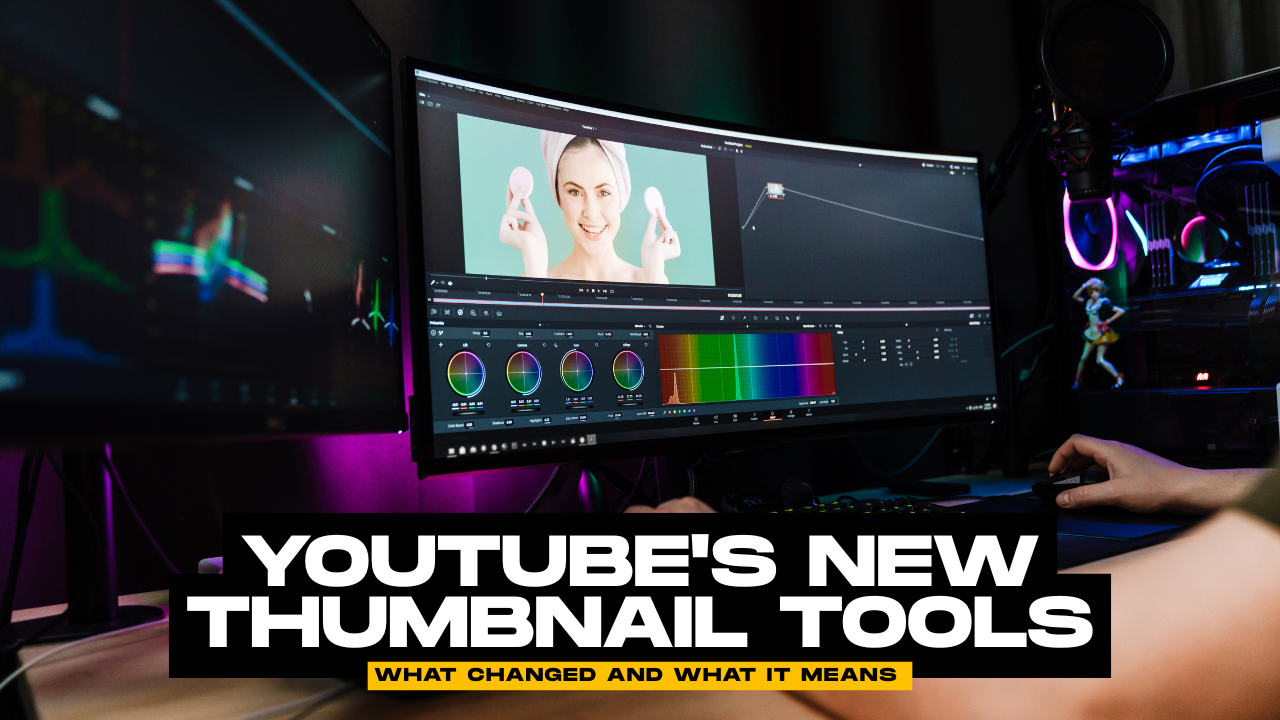
TL;DR: YouTube now lets podcasters upload custom thumbnails for Shorts and generate AI thumbnail concepts through Ask Studio. Data shows thumbnails already drive a large share of podcast clicks on YouTube, especially among younger listeners, making this update worth acting on now.
YouTube just handed podcasters more control over one of the most important discovery levers on the platform: the thumbnail. And the timing matters, because YouTube is leaning harder into video as a core part of the podcast experience, not a side feature.
Here's what changed, why it's worth paying attention to, and how to put it to work.
Hey Podcast Fam,
Creators in the YouTube Partner Program can now upload custom thumbnails for Shorts — something creators have been asking for. If you're clipping episodes into Shorts to drive traffic back to full episodes, you're no longer stuck with whatever frame YouTube auto-selects. You can use branding, guest photos, or episode artwork instead, and YouTube says this...
Why Podcasting's Future Is Still Very Human
Hey Podcast Fam,
AI is moving fast in podcast workflows — brainstorming, editing, research, admin. But when it comes to who's actually on the mic, listeners are drawing a clear line, according to research from Edison Research.
Listeners Have Tried AI Hosts — But Don't Want Them
About 1 in 4 first-year podcast listeners have tried an AI-narrated show, compared to roughly 1 in 5 long-time listeners. Trying isn't the same as embracing.
In follow-up interviews, the feedback was consistent: listeners want AI in the background, not on the mic. AI-generated hosts, they said, lack the emotional nuance, authenticity, and chemistry a human brings to a conversation.
Podcast Audiences Are Diversifying Fast
First-year listeners look different from the audience that built the medium. They're more likely to be women, younger, and more racially diverse — 39% are non-white, compared to 25% among long-time listeners.
Video Is a Bridge to Audio, Not a Replacement
Video is playing a growing role ...
Oxford Road Data: 80% of Top-Performing Podcasts Are Independent
Hey Podcast Fam,
For years, the "safe" bet in podcast advertising has been chasing legacy corporate networks. The logic seemed obvious: bigger network, bigger reach, bigger results.
But new data suggests that logic has it backwards.
Reach Is a Vanity Metric. Resonance Is an ROI Metric.
Oxford Road, a leading podcast ad agency, just released new rankings using their ORBIT tool — a system built to track actual advertiser ROI instead of estimated downloads. The findings: 80% of Oxford Road's top 15 performing podcasts, ranked by real ad performance, are independent shows produced outside major networks.
That's 8 out of the top 10 slots going to creators who own their audience directly, with no network attached.
The 4 "Performance Lanes" Behind Independent Success
Oxford Road's analysis identified four consistent categories where independent shows are winning:
🛠 The Build — Education & Business
Listeners in this lane aren't just consuming content passively — they're looking for a s...
